Bibimbap. Bibimbap (BEE-beem-bop): One of the most popular dishes in Korean cuisine, bibimbap is a nutritious rice dish of steamed rice and pre-cooked vegetables (usually spinach, bean sprouts, carrots. Bibimbap - Trust the Koreans to transform the humble rice bowl into a recipe that's revered all around the world! With a kaleidoscope of seasoned sautéed vegetables, Korean marinated beef, and the signature fried egg, the thing that really seals the deal is the bright red, spicy Bibimbap Sauce that I can't get enough of.
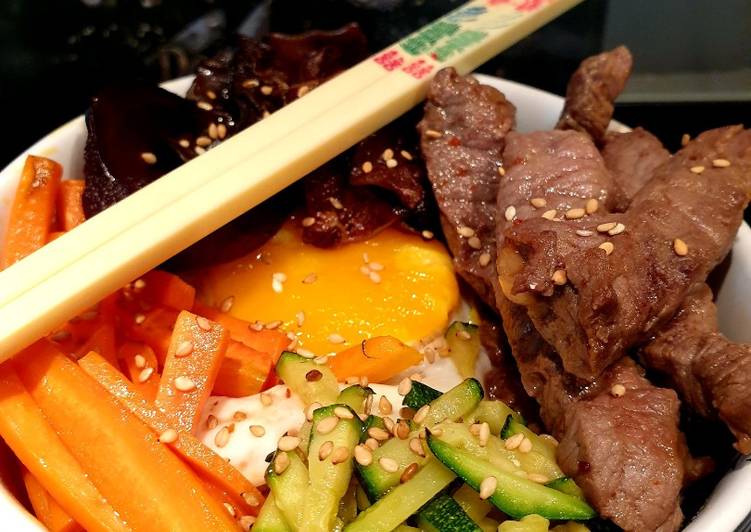 The term "bibim" means mixing various ingredients, while the "bap" noun refers to rice.
Bibimbap is served as a bowl of warm white rice topped with namul (sautéed and seasoned vegetables) or kimchi.
Along with kimchi, bibimbap takes its place among the favored foods in Korean cuisine.
You can cook Bibimbap using 14 ingredients and 11 steps. Here is how you cook it.
The term "bibim" means mixing various ingredients, while the "bap" noun refers to rice.
Bibimbap is served as a bowl of warm white rice topped with namul (sautéed and seasoned vegetables) or kimchi.
Along with kimchi, bibimbap takes its place among the favored foods in Korean cuisine.
You can cook Bibimbap using 14 ingredients and 11 steps. Here is how you cook it.
Ingredients of Bibimbap
- Prepare 140 g of filet de boeuf.
- Prepare 2 of oeufs.
- You need 60 g of riz rond arborio cru.
- You need 140 g of carotte.
- You need 140 g of courgette.
- It's 20 g of champignons (noirs ou shiitake).
- You need of sauce soja salée.
- You need of huile de sésame.
- Prepare of ail.
- It's of sel.
- It's of poivre.
- You need of piment.
- Prepare of miel.
- It's of gingembre.
Literally meaning 'mixed rice,' it's a popular meal consisting of white rice topped with vegetables, beef, a whole egg, and gochujang (red chili pepper paste). Bibimbap (비빔밥) is a large bowl of rice topped with an array of individually prepared vegetables and meat and served with a gochujang (고추장) sauce. Bibim means mixing, and bap means rice. The mixing usually happens at the table by the diner.
Bibimbap instructions
- Couper la viande en fines lamelles ou petits morceaux. Il faut que le plat reste pratique à manger avec des baguettes..
- Préparer une marinade avec du gingembre, de l'ail, du piment, de l'huile de sésame, du miel et de la sauce soja salée. Vous pouvez également ajouter du mirin si vous en avez..
- Laisser mariner la viande dans ce mélange au moins 20 minutes..
- Pendant ce temps, cuire le riz comme indiqué sur le paquet..
- Laver et préparer les légumes. Les tailler en fine julienne. Si vous utilisez les champignons noirs, les réhydrater et les cuire selon les indications sur le paquet..
- Dans un wok bien chaud, verser un peu d'huile de sésame et faire revenir les légumes. Attention, chacun leur tour, il ne faut pas mélanger pour garder les saveurs de chaque légume. Les réserver au chaud..
- Dans le même wok, faire ensuite revenir la viande avec sa marinade..
- Commencer à dresser en disposant le riz dans un bol puis les garnitures par dessus en alternant les couleurs..
- Finir par faire cuire l’œuf au plat et le déposer délicatement sur le bol. Vous pouvez aussi le mettre directement sur le riz et les garnitures en dernier (comme sur la photo)..
- Optionnel : parsemer de quelques graines de sésame..
- Il n'y a plus qu'à tout mélanger et à déguster !.
Bibimbap simply translates to "mixed rice with meat and assorted vegetables". You can make endless variations to this dish depending on your preference and dietary requirements (e.g. microgreens bibimbap) and also based on the dish/bowl it is served in (e.g. dolsot bibimbap and yangpun bibimbap). Bibimbap traditionally is topped with Gochujang, but I used kimchi because I just wanted to use what I already had on hand. While Gochujang is traditional, they're both delicious with this dish, IMHO. :) While it looks like there is a lot going on in this bowl, I promise it's super quick and easy. If I hadn't been stopping to take photos.